 |
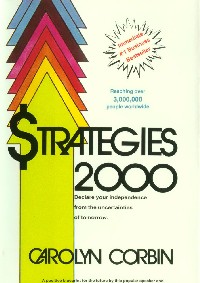
Strategies 2000
Declare your independence
from the uncertainties of tomorrow.
By Carolyn Corbin
Publication Date:
1986
ISBN: 0-89015-575-5
$14.95
|
Full Description /
About the Author
/ Reviews
95 Percent of Carolyn Corbin’s Claims
Made in 1986 Are Happening Today
In 1985 and early 1986, Carolyn Corbin wrote Strategies
2000. At that time, Japan was competing heavily with U.S. manufacturing and
financial systems. Oil had dropped to around $9.00 per barrel. Americans were
losing their jobs in great numbers. People were confused and frightened about
the future. In this setting, Carolyn Corbin dared to make some realistic yet
positive, interesting, and powerful claims about the turn of the century.
Approximately 95% of the assertions she made about the years around the new
century are coming true. She described such phenomena as the Internet, shift in
power to knowledge businesses and knowledge workers, and the move to
e-commerce--although she did not use these specific labels at the time. Here are
some of the ideas she projected in 1986 about what would be happening around the
year 2000:
-
The economy and workforce will be
globalized.
-
The world will be technologically interconnected. The masses
will use this network. (Now we call this system the
Internet.)
-
Economic power will shift from traditional business people
to proprietors of information.
-
There will be increasing need for spiritual balance although
most people will be materially better off.
-
Individual responsibility will be emphasized.
-
There will be no guarantees of job security made by
organizations.
-
The U.S. economy will be very good.
-
All socioeconomic processes will speed up.
-
People who gather, manage, store, manipulate, and convert
information will gain power. (Now these people are called
knowledge workers.)
-
Turn-of-the-century corporations that are successful will
become big and powerful and/or unique; practice long-range
planning even in a swiftly changing competitive economy;
pool corporate resources for economies of scale; pare
overhead to compete in an economy with narrow profit
margins; emphasize the importance of people to the
organization’s success. The business world will be as
different from that of the 1980s as the world of the 1980s
was different from the era of the Pony Express. (Now we call
this phenomenal difference e-commerce.)
Rather than treat people as a disposable commodity,
successful companies will treat people as an economic
necessity and will design programs and schedules around
employee lifestyle needs.
Out of print - Please
e-mail
for more information or check our store at
Amazon.com for more books by Carolyn Corbin.
|